
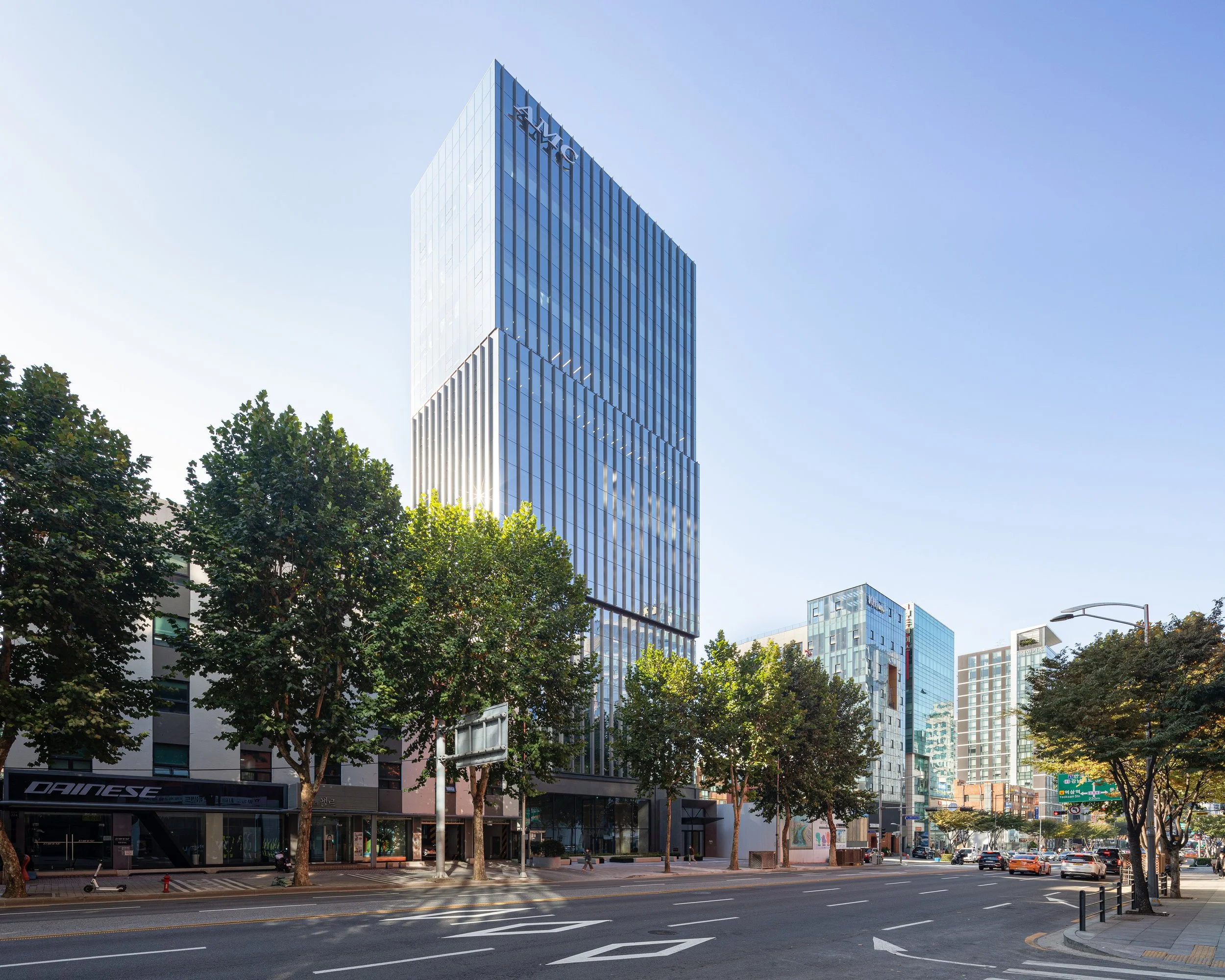
AMC 역삼 사옥
도시적 여백으로서의 전면: 도시 맥락, 개발, 공공성
AMC 사옥은 급변하는 도시 환경 속에서 밀도와 효율, 그리고 도시적 공공성 사이의 균형을 모색한다. 본 계획은 제한된 도심 대지 안에서 상업적 잠재력을 극대화하는 동시에, 파편화된 도시 조직에 새로운 보행 흐름과 개방형 공공 공간을 삽입함으로써 가로와 능동적인 관계를 맺는 건축을 제안한다.
대지는 강남구 역삼동, 언주역과 경복아파트 사거리 사이에 위치하며, 서로 다른 규모와 성격의 프로그램이 느슨하게 중첩된 도시 맥락 안에 놓여 있다. 주변은 일관된 도시 질서보다 개별 건축물들의 독립적 논리가 우세한 환경으로, 서로 다른 스케일과 흐름이 충돌하며 복합적인 도시 풍경을 형성한다. 특히 L자형의 프로젝트 부지는 코너의 기존 상업 건물과 직접 맞닿아 있어, 단순한 매스 배치를 넘어서는 도시적 해석과 공간적 전략이 요구되었다.
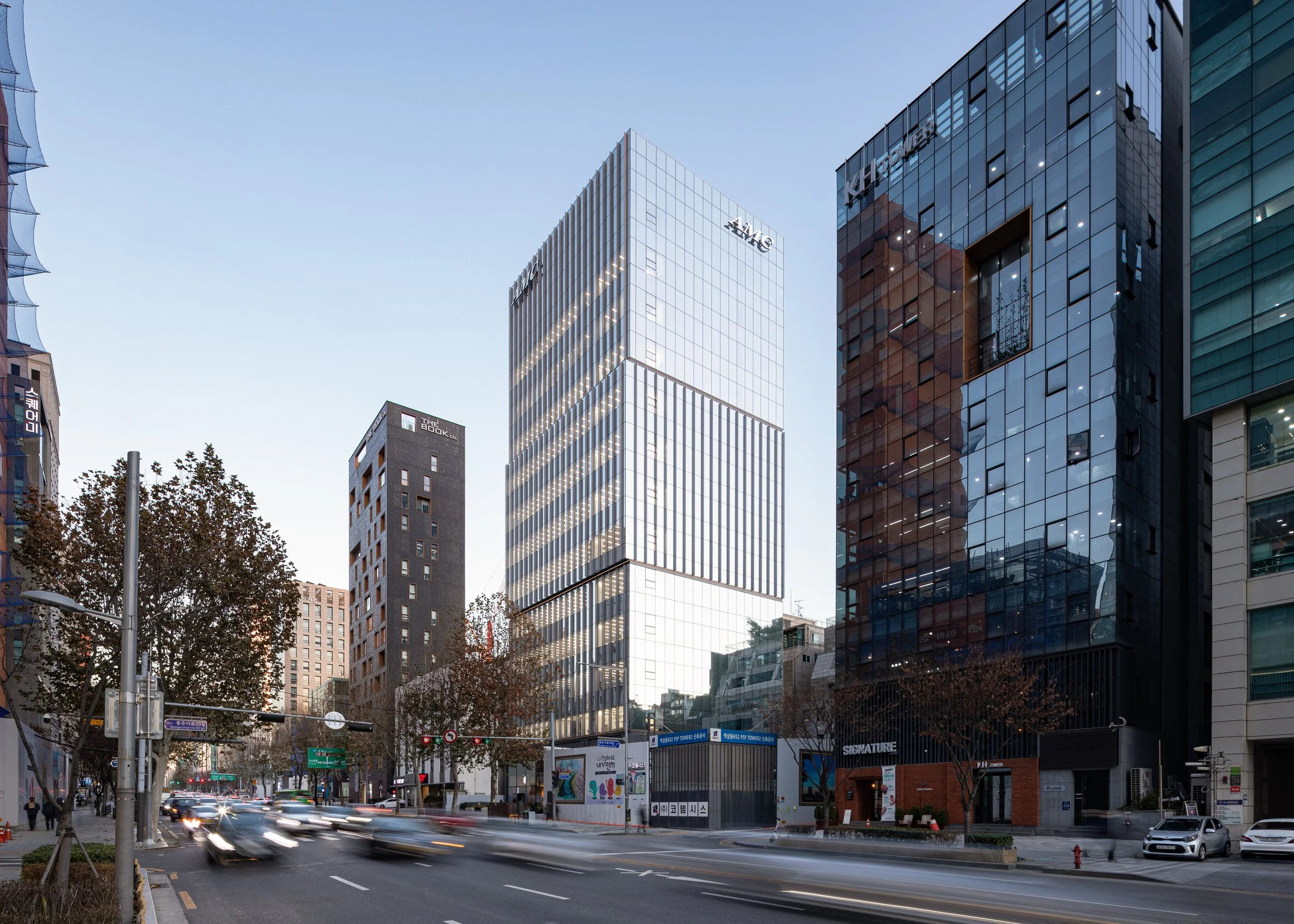
차량 진입 동선을 이면도로로 계획함으로써, 보행 흐름과 차량 동선을 명확히 분리하고, 이를 통해 사옥의 주 입면 전체를 보행자를 위한 열린 공간으로 확보한다. 봉은사로를 따라 적용된 8m의 건축선 후퇴는 강남의 고밀도 가로 환경에서는 드물게 경험되는 깊이의 전면 공공 공간을 형성하며, 이는 단순한 공개 공지를 넘어 도시적 시퀀스와 보행 흐름을 조직하는 장치가 된다. 매스는 복합적인 도시 스케일 사이를 조율하며 분절과 후퇴, 연결을 반복하고, 그 과정에서 형성된 틈과 공백은 광장, 보행 공간으로 전환된다. 이렇게 비워진 공간은 건축보다 먼저 인식되는 도시적 여백이 된다.
건축적 텍토닉 - 구조, 모듈, 비례, 물성
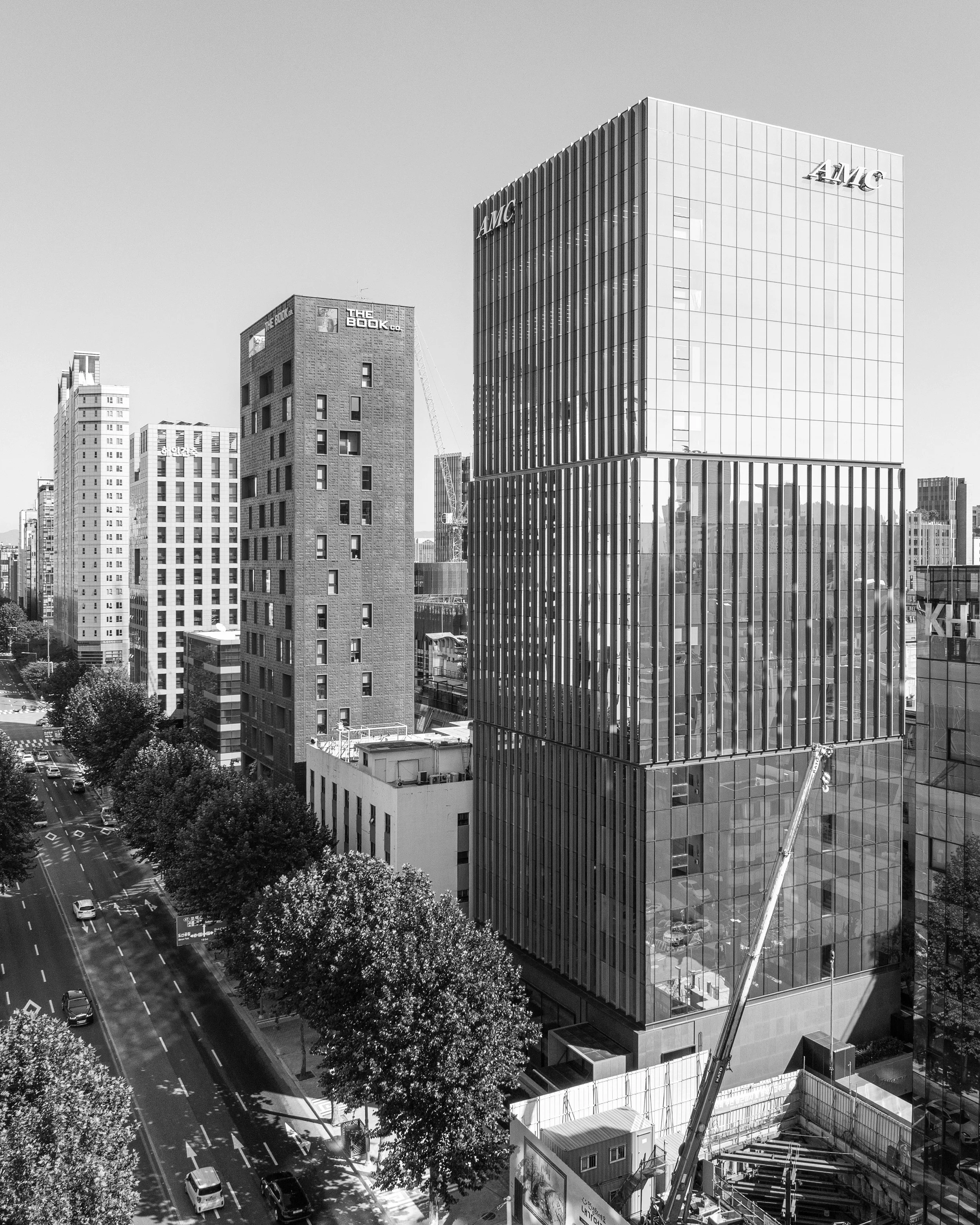
AMC 사옥 타워는 봉은사로를 향해 최대 전면 길이로 확장되며, 동–서 방향의 수평성을 강조하는 직사각형 매스로 계획되었다. 지상층은 상부 타워와 물성을 명확히 구분한 견고한 석재 포디움으로 구성되어, 도심 조직 속에서 건축의 기단성을 강조한다. 전면으로 돌출된 거대한 석재 포털은 타워의 스케일을 인간적인 비례로 환원시키는 동시에, 보행자를 위한 주출입구를 형성한다.
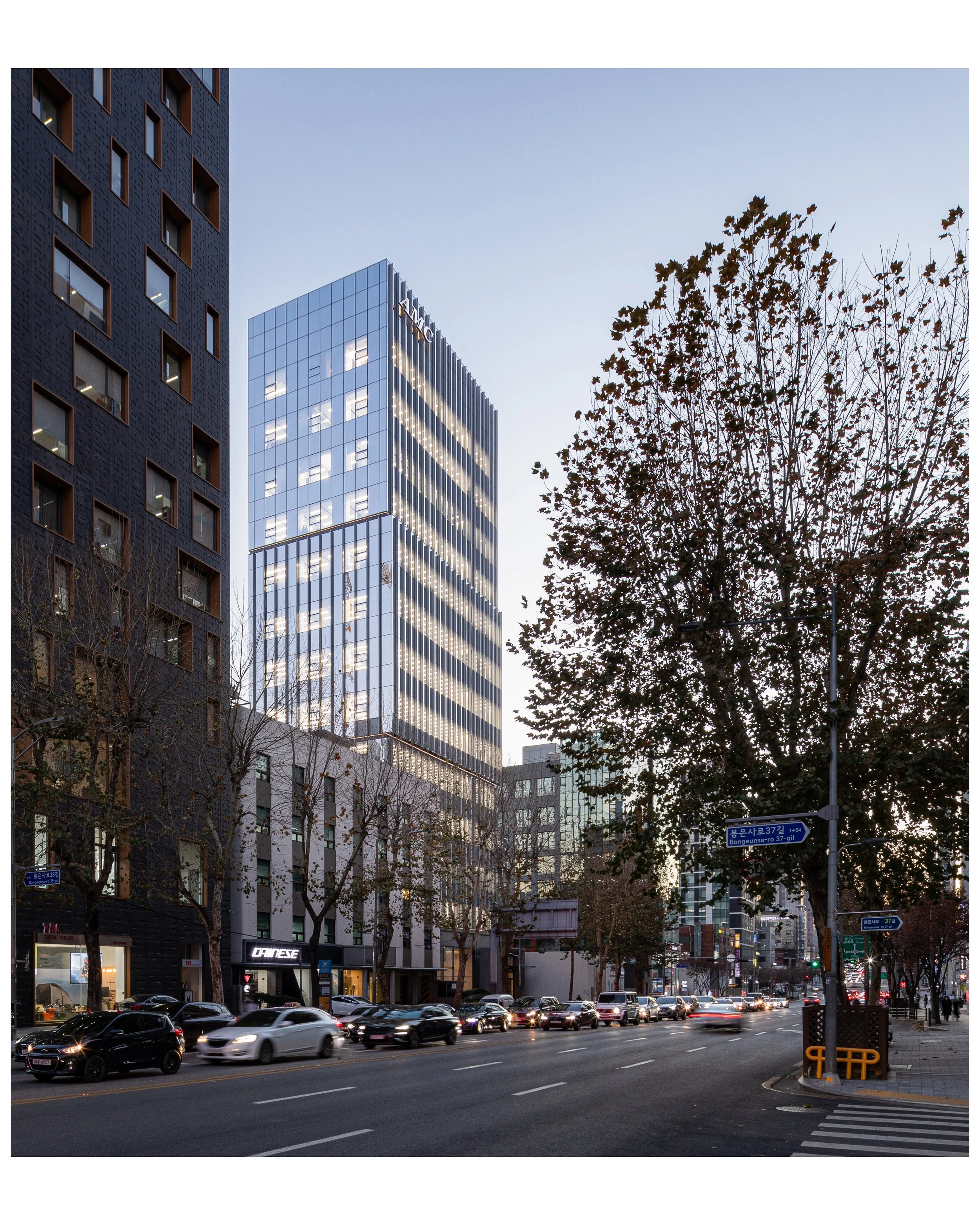
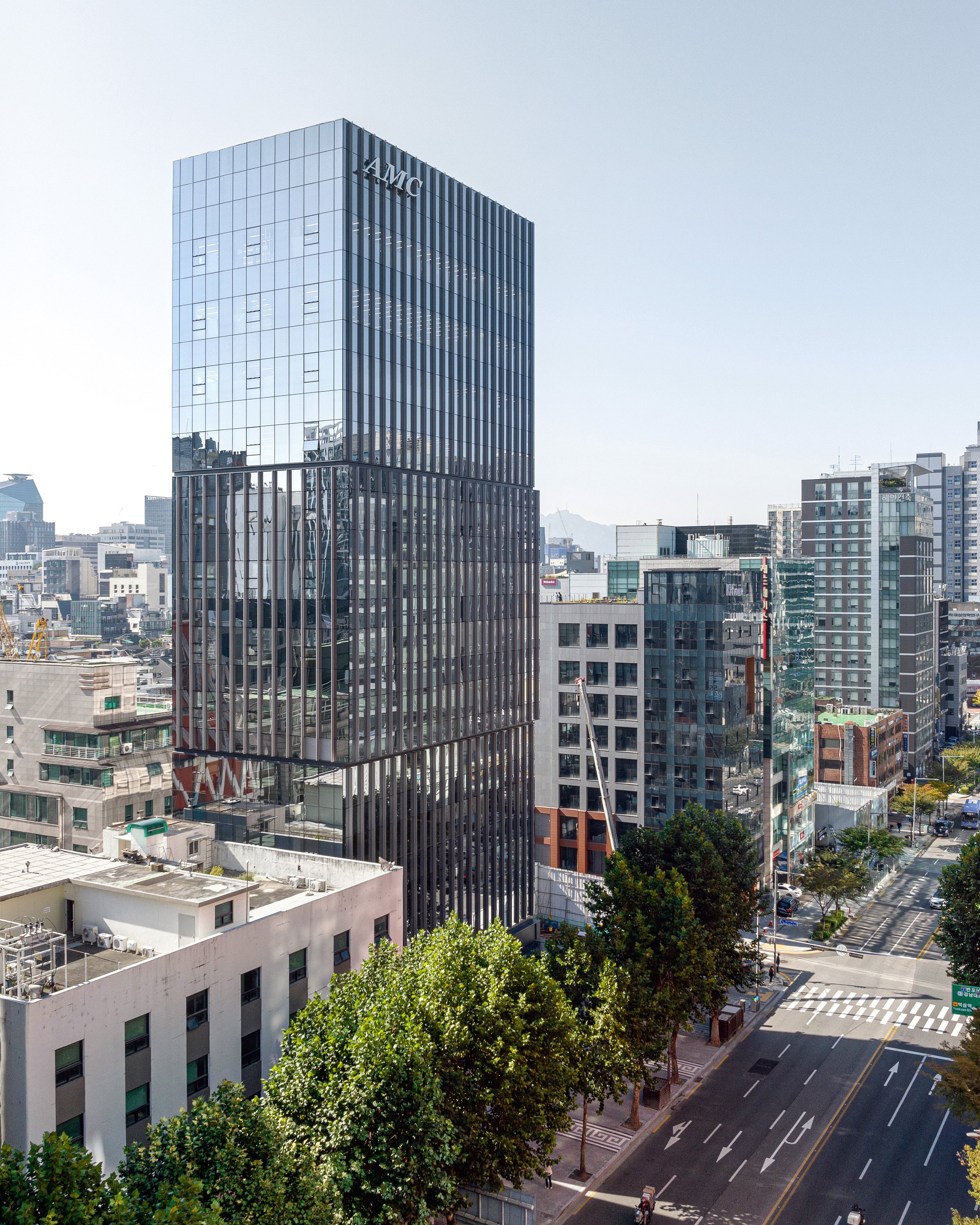
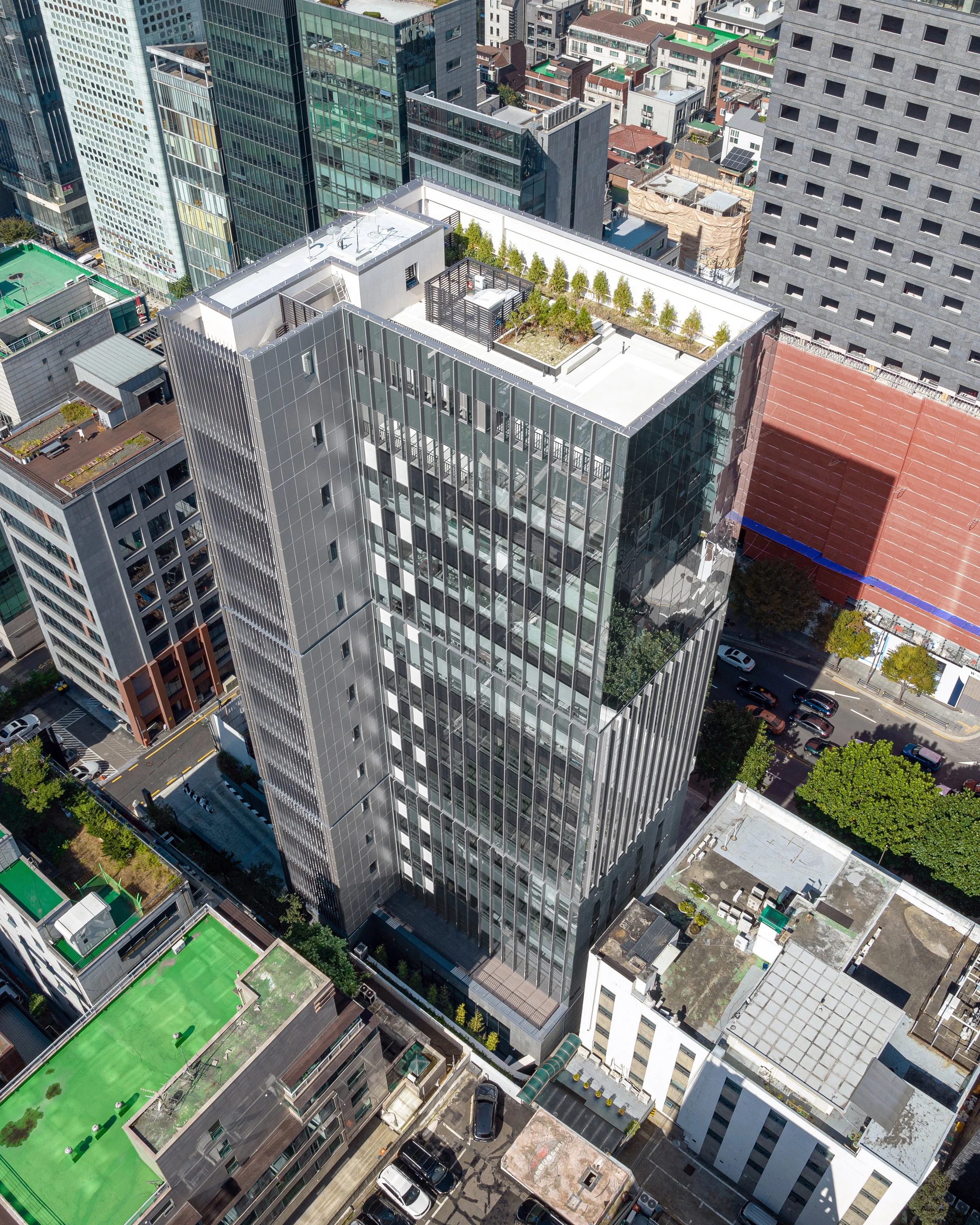
상부는 총 12개 층의 타워를 세 개의 유리 볼륨으로 분절하여 구성함으로써, 구조와 비례에 기반한 건축적 텍토닉을 드러낸다. 입체적 분절감을 극대화하기 위해 상·하부 볼륨은 후퇴시키고, 중앙 볼륨은 캔틸레버로 돌출시켜 입체적 긴장감을 형성한다. 각 유리 매스의 경계에는 C자형 프로파일을 적용하여 야간에는 은은한 간접 조명 채널로 기능하도록 계획하였다.
입면은 6,200mm 구조 그리드를 등분한 1,240mm 모듈을 기반으로 구성되며, 수직 핀과 커튼월 리듬을 통해 질서를 형성한다. 특히 동·서측 입면의 수직 핀은 중앙 캔틸레버 매스에만 적용되어, 돌출된 볼륨의 깊이감과 입체성을 더욱 강조하고, 구축적 질서를 드러낸다.
지상층은 입면 중앙을 기준으로 프로그램적으로 분절된다. 서측은 사옥 로비로 계획되며, 반대편에는 로비와 연계된 F&B 공간이 배치되어 외부 공공 공간에서도 직접 접근이 가능하도록 구성하였다. F&B 공간과 연결된 후면 테라스는 대나무 정원으로 계획되며, 2층과 연계된 계단식 테라스를 통해 도시와 건축, 조경이 중첩되는 다층적 공간 경험을 형성한다.
지상층 입면 모듈은 상부 타워 모듈과 정렬되며, 이러한 수직적 정합은 입면의 질서를 지면까지 연장시킨다. 이에 따라 입면의 수직선은 공공 공간 조경의 경계와 리듬을 형성하며, 건축과 외부 공간 사이의 연속적인 공간 질서를 구축한다.
남측 스팬드럴 존에는 건물일체형 태양광(BIPV)을 적용하여 신재생에너지 기준을 충족시키는 동시에, 옥상 공간이 태양광 패널에 점유되지 않은 순수한 개방 공간으로 유지되도록 계획하였다. 측면의 수직 콘크리트 코어와 벽체에는 스팬드럴과 동일한 반사 유리 커튼월 시스템을 적용하여, 주간에는 비전 존과 스팬드럴 존의 경계를 모호하게 만든다. 이를 통해 타워는 분절된 요소들의 조합이 아닌, 단일한 물성을 지닌 추상적 매스가 된다.
본 프로젝트는 비례와 물성, 구조와 모듈의 통합을 통해 구축적 질서를 명확히 드러내며, 일시적 이미지나 장식적 제스처를 지양하고, 건축적 텍토닉의 본질적 표현을 통해 시대성을 초월하는 절제된 존재감과 지속성을 구축한다.
내부 공간, 위계, 그리고 내부 요소의 외부화 - 천장 조명과 외부 조명
업무 공간에는 약 19m 경간의 포스트텐션 콘크리트 보가 적용되어 기둥 없는 평면을 확보하며, 내부 공간의 유연성과 활용 가능성을 극대화한다. 선형 조명 그리드는 입면 모듈과 동일한 간격으로 남–북 방향으로 배치되되, 반 모듈만큼 이동되어 설치된다. 이는 수직 멀리언 사이의 존재감을 드러내며, 외부를 향한 조명으로 작동하여 건물 내부와 외부를 자연스럽게 연결한다. 이러한 조명 구성은 내부 조도를 확보함과 동시에, 가변적인 내부 파티션 구성을 가능하게 한다.
이와 같은 선형 조명과 유리 매스 경계의 C자형 프로파일 조명은 자연스럽게 외부 환경 조명으로 확장된다. 디퓨저와 스프링클러와 같은 기술적 천장 요소들은 동–서 방향으로 정렬되어, 짙은 회색 금속 케이스 안에 수용되며 조명 요소와의 위계를 명확히 한다.
12층에 위치한 회의실은 스테인리스 스틸 마감으로 처리되어 내부 공간 속 하나의 오브제로 작동하며, 임원층을 방문하는 방문객을 맞이하는 공간으로 기능한다. 이 내부 매스에는 전기변색 유리가 적용되어, 공간의 프라이버시를 상황에 따라 조절할 수 있다.
11층과 12층을 연결하는 개방형 내부 계단은 직원 간의 소통을 촉진한다. 회장실이 위치한 13층에는 방문객 대기 공간과 리셉션 데스크 사이에 테라스를 배치하여 자연채광을 유입시키며, 폴딩 도어를 통해 실내외 공간을 이벤트 시 통합할 수 있도록 계획되었다.
주차 공간 및 부대 시설
봉은사로 일대의 유사 규모 업무 시설들이 규모 및 효율성의 한계로 인해 주차 타워를 주로 계획하는 것과 달리, AMC 사옥 타워는 지하 3개 층에 걸쳐 약 90대의 자가 주차 공간을 확보하고 지하 4·5층에는 자동화 기계식 주차 시스템을 도입하였다. 주차 공간에는 곡선형 선형 조명이 적용되어 차량의 이동을 자연스럽게 하부 층으로 유도한다.
© INTERFACE STUDIOS 2026, ALL RIGHTS RESERVED
AMC Headquarters Tower
Frontage as Urban Void: Urban Context, Development and Public Space
AMC Headquarters tower explores the balance between density, efficiency, and urban publicness within the rapidly changing urban fabric. The project maximizes commercial potential on a constrained site while inserting new pedestrian flows and open public space into the fragmented city context, establishing an active relationship between architecture and the city.
Located between Eonju Station and the Gyeongbok Apartment intersection in Yeoksam-dong, the site is surrounded by a loose mix of programs and scales. Within this heterogeneous urban condition, the L-shaped site directly adjoins an existing commercial building at the corner, demanding a spatial strategy beyond a conventional massing approach.
Vehicular access is relocated to the rear street, allowing the tower’s primary frontage to be fully opened to pedestrians. An 8-meter setback along Bongeunsa-ro creates a rare depth of public space within Gangnam’s dense streetscape, functioning not simply as an open plaza but as an urban device that organizes movement, sequence, and perception. The mass negotiates varying urban scales through repetition of separation, recession, and connection, while the resulting voids transform into plazas, pedestrian spaces, and zones of visual permeability. These emptied spaces become an urban void perceived before the architecture itself.
Architectural Tectonics - Structure, Module, Proportion, Materiality
The AMC Headquarters Tower is conceived as a rectilinear mass extending along Bongeunsa-ro, emphasizing a strong east–west horizontality within the urban fabric. A robust stone podium anchors the tower at ground level, clearly distinguished in materiality from the glazed volumes above, reinforcing the building’s tectonic base. A monumental projecting stone portal mediates the tower’s scale into a more human proportion while framing the primary pedestrian entrance.
The twelve-story tower is articulated into three distinct glass volumes, expressing an architectural tectonic grounded in structure and proportion. To intensify the perception of volumetric depth, the upper and lower masses are recessed while the central volume projects outward as a cantilever, generating spatial tension and three-dimensional articulation. C-shaped profiles along the edges of each glass mass integrate concealed indirect lighting, allowing the tower to emit a subtle luminous presence at night.
The façade is organized through a 1,240 mm module derived from the subdivision of the 6,200 mm structural grid. Vertical fins and curtain wall rhythms establish a disciplined tectonic order, while fins applied exclusively to the east and west façades of the cantilevered central mass further emphasize its depth and projection.
At ground level, the program is divided around the central façade axis. The western side accommodates the corporate lobby, while the opposite side contains an F&B space directly connected to the public realm. A rear bamboo garden terrace extends from the F&B program into stepped terraces linked to the second floor, creating a layered spatial experience in which architecture, landscape, and city overlap.
The ground-floor façade module aligns precisely with the tower module above, extending the vertical order of the elevation seamlessly to the ground plane. These vertical lines continue into the landscape, organizing the boundaries and rhythms of the public space and establishing a continuous spatial order between architecture and exterior environment.
Building-Integrated Photovoltaics (BIPV) are incorporated into the south spandrel zones to satisfy renewable energy requirements while preserving the rooftop as an unobstructed open space. Reflective glazing applied consistently across both vision and spandrel zones visually dissolves the distinction between solid and void, allowing the tower to read as a singular abstract mass rather than an aggregation of fragmented elements.
Through the integration of proportion, materiality, structure, and modular order, the project articulates a clear tectonic discipline. Rejecting temporary imagery and decorative gestures, it pursues an essential architectural expression that constructs a restrained yet enduring presence capable of transcending stylistic temporality.
Internal Space, Hierarchy and Externalization of Internal Space Elements - Ceiling Lighting, Exterior Lighting
The post-tensioned concrete beams applied at the office floors span approximately 19m, providing column-free spaces and offering maximum flexibility versatility to the internal space. The linear lighting ceiling grid runs in North-South direction, following the same spacing as facade module, but is shifted by half a module, visibly exposes the presence between the vertical mullions and serves as exterior lighting, naturally illuminating towards the outside. This not only provides the necessary lighting within the building but also grants maximum flexibility for interior partition configuration to the interior space.
The linear lighting installed in this manner, along with the C-shaped profile lighting at the border of the glass mass, seamlessly transitions into ambient exterior lighting. Technical ceiling elements such as diffusers and sprinklers are arranged along East-West direction, residing in dark gray-painted metal housings, delineating the hierarchy of ceiling components between lighting and other elements.
Conference room on 12th floor is wrapped in stainless steel finish serves as an object within the internal space, welcoming visitors to the executive floor. Electrochromic glass is applied to the internal mass, allowing for adjustable transparency to ensure the desired privacy within the space.
The open interconnecting staircase between the 11th and 12th floors enhances and promotes communication between staff members. On the 13th floor, where the chairman's office are located, a terrace is positioned to provide natural lighting between the waiting area for visitors and the reception desk. Folding doors are placed to integrate the indoor and outdoor spaces for events.
Parking Space and Amenities
While similar scale office buildings on Bongeunsa-ro primarily plan parking towers to meet statutory parking requirements due to site limitations and efficiency, the AMC Headquarters Tower secures approximately 90 self-parking spaces across three basement levels. In addition, an automated mechanical parking system is incorporated on Basement Levels 4 and 5 to maximize parking capacity and operational efficiency. Curved linear lighting is integrated throughout the parking areas, intuitively guiding vehicle circulation and leading drivers naturally toward the lower levels.
Location 222, Bongeunsa-ro, Gangnam-gu, Seoul, Republic of Korea
Programme HQ. Office, Retail
Site Area 1,108.10 m2
Building Area 509.01 m2
Gross floor Area 4,948.08 m2
Building Scope 13F, 5 basement floors
Parking 89
Height 66.1 m
Building to land ratio 45.94 %
Floor area ratio 446.54 %
Structure RC with post-tension concrete beam
Exterior finishing Reflective Glass, BIPV panel, Painted aluminum
Interior finishing Marble, artificial stone, stainless steel, eco-friendly paint
© INTERFACE STUDIOS 2026, ALL RIGHTS RESERVED