Mixed Use in Magok
The project is situated at the peripheral edge of the Magok Urban Development District Unit Plan, occupying a relatively small parcel within Seoul yet characterized by the uncommon condition of dual street frontage. The site addresses Gangseo-ro—an eight-lane arterial road—along its eastern edge, while simultaneously engaging Magokjungang 8-ro 7-gil, a two-lane secondary street, at the rear. While Gangseo-ro operates primarily at the scale of vehicular infrastructure and lacks pedestrian-oriented urban programs, the internal back street demonstrates latent potential to evolve into a pedestrian-friendly environment as adjacent office and research-based mixed-use developments continue to materialize.
Originally conceived under the conventional imperative of maximizing floor area ratio, the project critically reframes this objective by interrogating how a private building might incorporate public space and circulation as an urban strategy. Rather than treating density as a purely quantitative outcome, the proposal positions architectural form and spatial organization as instruments capable of activating the surrounding streetscape and offering a public connective passage embedded within the building mass.
On the mid-block rectangular site—bounded by neighboring buildings to the north and south—the primary entrance is aligned with the major frontage and spatially linked to a secondary entrance at the rear through an internalized urban corridor. This corridor operates as a shared spatial infrastructure for pedestrians, ground-floor neighborhood commercial users, and residents, while maintaining controlled access to upper-level programs through a secured elevator lobby. As a planar public device, the urban corridor enables movement, encounter, and continuity without reliance on pilotis or externalized outdoor passages, thereby redefining publicness within an enclosed architectural framework.
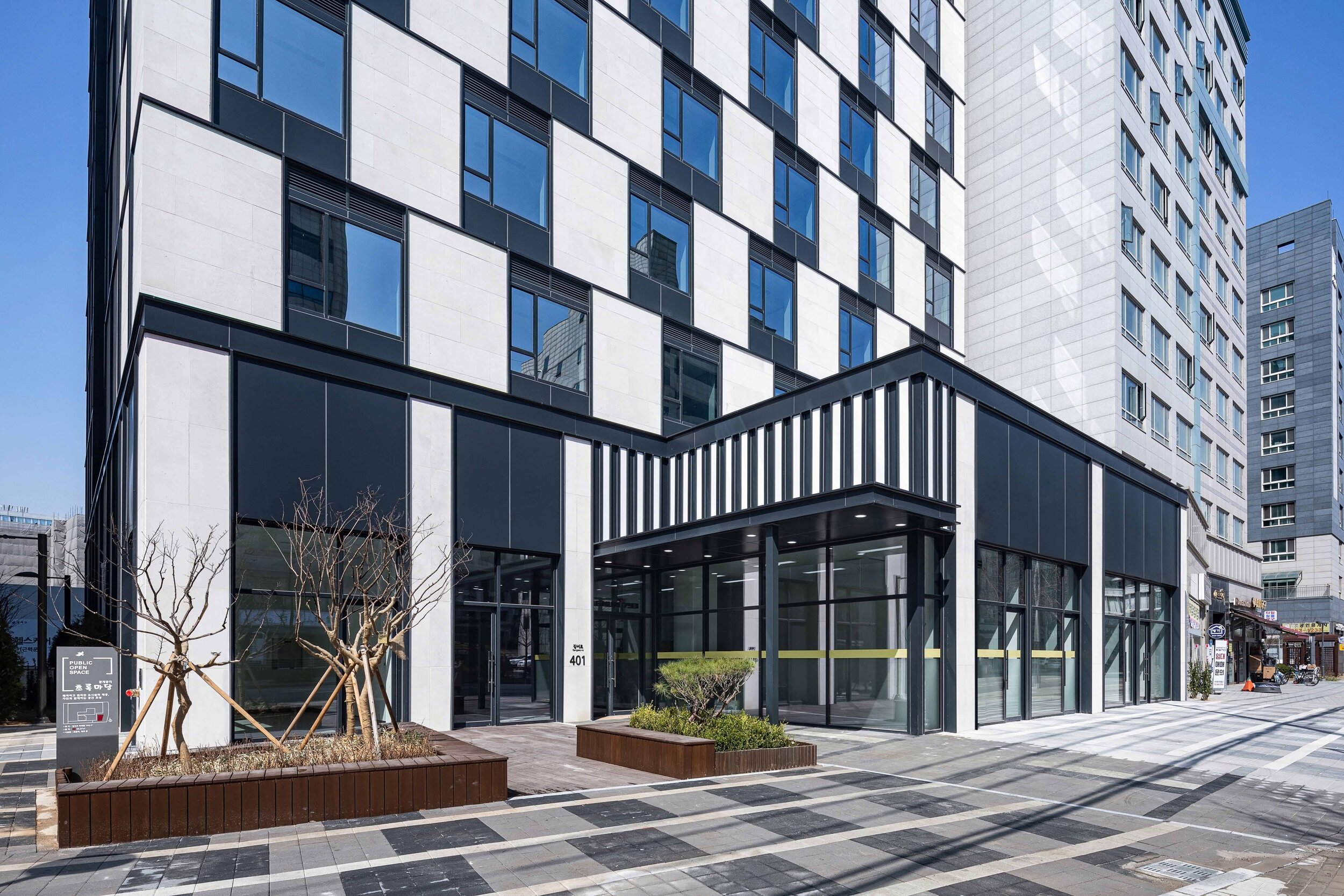
The main entrance is further articulated through its relationship with a publicly accessible open space that functions simultaneously as a landscaped buffer and a pedestrian resting zone. At ground level, the maximum feasible allocation of neighborhood commercial programs reinforces street-level activity and urban permeability. The typical residential floor is organized as an optimized ‘H’-shaped layout, achieved through the strategic concentration of core elements and the calibration of front and rear visual connections to enhance spatial efficiency and environmental quality.
Arrival at the upper floors is choreographed through a sequence in which the elevator opens directly toward a daylight aperture. Adjacent seating areas, in conjunction with the naturally lit corridor, are conceived as social condensers that encourage visual exchange and informal interaction among residents. The residual pockets generated by the ‘H’-shaped configuration are appropriated as collective spaces, accommodating a second-floor terrace and a landscaped rooftop garden that extend the notion of community beyond the individual unit.
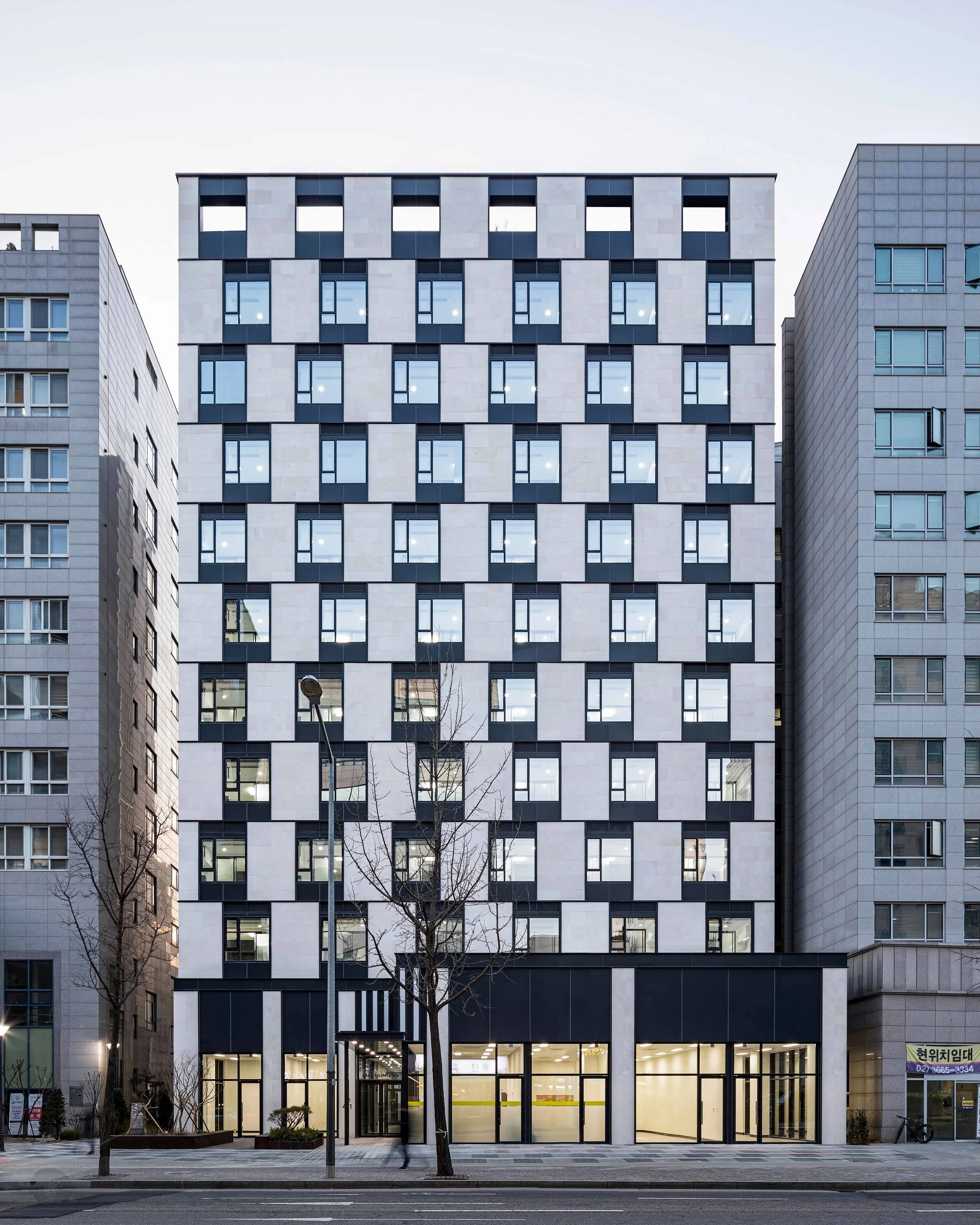
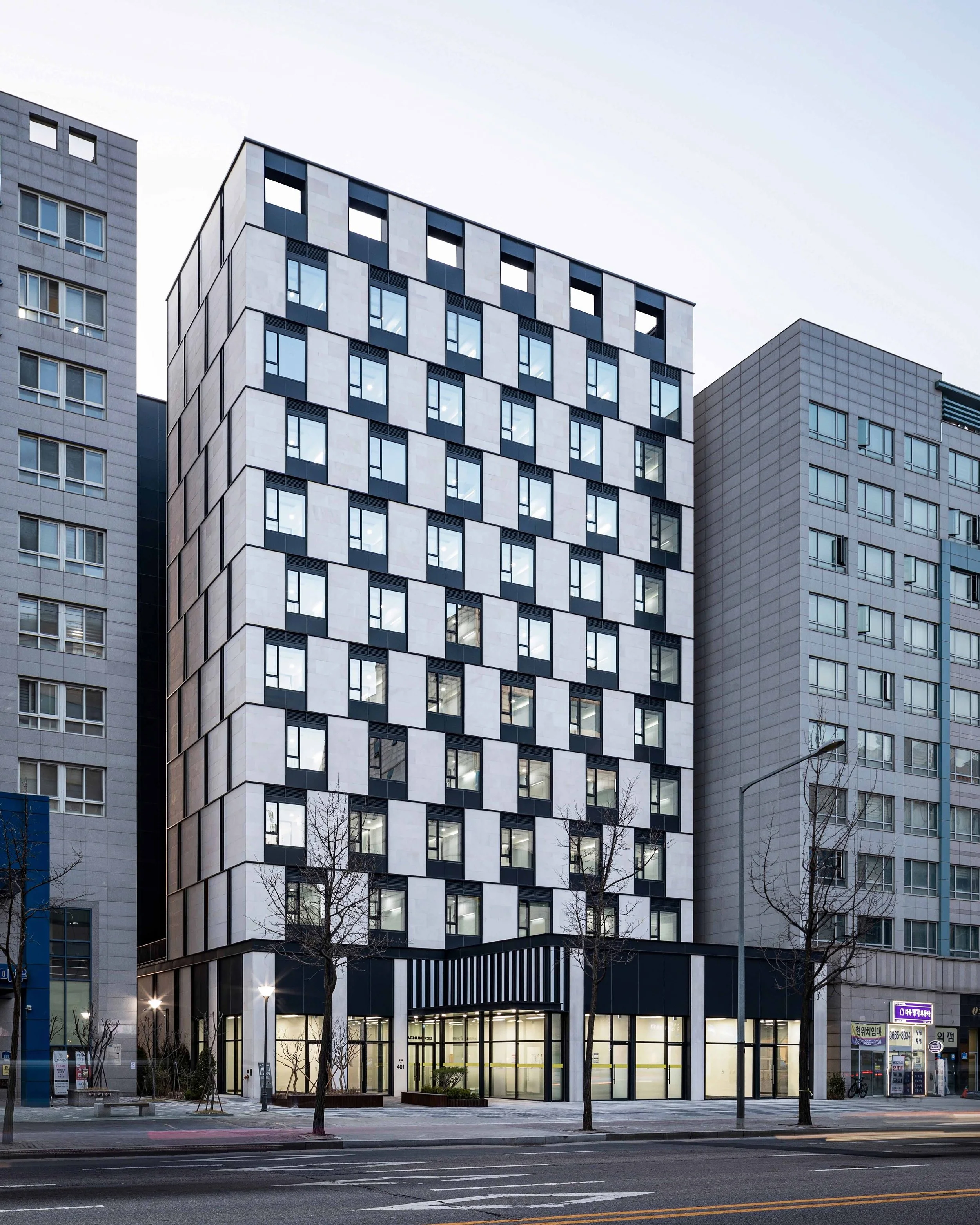
The façade articulation emerges from the systematic inversion of the residential bedroom layouts, producing a half-module horizontal shift at each level and resulting in a two-story rhythmic repetition. Limestone, employed as the primary façade material, registers the building’s presence through the subtle chromatic and textural variations inherent to natural stone. The façade is conceived as a three-dimensional field shaped by a calibrated understanding of light and shadow: metal panel and glass surfaces are recessed 40 mm behind the limestone plane, while protruded frames extending 30 mm horizontally and vertically articulate the boundaries between materials and floor levels. Through this layered relief, each material maintains its own planar autonomy while contributing to a continuous depth condition.
This tectonic strategy enables multiple visual interpretations under shifting daylight conditions. Moreover, the alignment of protruded frames generates an optical effect of diagonal displacement across the façade, disrupting the monotony of the surrounding streetscape and establishing a subtle yet persistent dialogue between the building, the street, and its occupants—positioning the architecture not as an isolated object, but as an active mediator within the urban continuum.

마곡 업무 근린 생활시설
본 프로젝트는 마곡 도시개발사업 지구단위계획의 가장자리에 위치하며, 서울의 소규모 대지 중에서도 동·후면이 각각 서로 다른 성격의 도로에 접하는 드문 양방향 접근성을 지닌 부지에 자리한다. 대지의 동측은 8차선의 광역 간선도로인 강서로에 면하고 있으며, 후면은 마스터플랜 내부 이면도로인 마곡중앙8로 7길과 접한다. 강서로가 차량 중심의 스케일과 주변 프로그램의 결핍으로 인해 보행 친화성이 낮은 반면, 마곡중앙8로 7길은 인접한 업무·연구 복합시설 개발의 진전에 따라 점진적으로 보행자 중심의 도시 가로로 전환될 잠재력을 내포하고 있다.
본 계획은 태생적으로 용적률의 최대화를 전제로 출발하였으나, 이를 단순한 밀도 확보의 문제로 환원하지 않고, 사적 건축 내부에 공적 공간과 동선을 어떻게 삽입할 수 있는가라는 질문을 통해 재해석한다. 즉, 건축을 하나의 ‘도시적 장치(urban apparatus)’로 설정하고, 이를 통해 주변 가로의 활성화와 도시 조직 내 공공적 연결 통로의 가능성을 탐색하고자 한다.
남·북측으로 인접 대지 건물에 의해 둘러싸인 mid-block 형태의 직사각형 대지 조건 속에서, 건물의 주출입구는 전면 가로에 대응하여 배치되며, 후면의 부출입구와는 내부화된 urban corridor를 통해 직접적으로 연결된다. 이 공공 복도는 보행자, 1층 근린생활시설 이용자, 그리고 거주자가 공유하는 공간적 인프라로 작동하며, 엘리베이터 홀에서 상층부 프로그램에 대한 접근 통제를 통해 주거의 보안성을 동시에 확보한다. 이는 필로티나 외부 통과 공간에 의존하지 않고도, 평면적 장치를 통해 공적인 이동과 우연적 만남을 가능하게 하는 공간 전략이다.
주출입구는 보행자 휴식과 조경을 겸하는 공개공지와 연계되어 배치되며, 지상층에는 최대한의 근린생활시설을 수용함으로써 가로 수준에서의 도시 활동을 적극적으로 유도한다. 기준층 평면은 코어 요소의 집중 배치와 전·후면 조망의 확보를 통해 효율적으로 조직된 ‘H’자형 레이아웃으로 구성된다.
상부층에서 엘리베이터를 통해 도달하는 순간, 사용자는 정면에 배치된 채광창을 마주하게 되며, 이와 연계된 seating area는 자연 채광이 유입되는 복도 공간과 함께 세대 간 시선의 교차와 비형식적 소통을 유도하는 사회적 응축 공간으로 작동한다. ‘H’형 평면에서 발생하는 포켓 공간에는 2층 테라스와 옥상 조경 공간이 배치되어, 개별 주거를 넘어선 커뮤니티 차원의 공유 공간을 형성한다.
입면 구성은 주거 유닛의 침실 레이아웃을 층별로 반전시키는 전략에서 출발하며, 이에 따라 각 층은 반 모듈씩 수평 이동하고, 2개 층 단위의 반복적 리듬을 형성한다. 입면의 주재료인 라임스톤은 천연석 고유의 미묘한 색감과 텍스처의 변화를 통해 건물의 존재감을 절제된 방식으로 드러낸다. 입면은 빛과 그림자에 대한 인식을 바탕으로 입체적으로 구성되었으며, 메탈 패널과 유리로 마감된 면은 라임스톤 면보다 40mm 후퇴 배치되어 재료 간 깊이감을 형성한다.
재료의 경계 및 층간 경계에는 수직·수평 방향으로 30mm 돌출된 프레임을 적용함으로써, 각 재료는 고유한 평면성을 유지하는 동시에 연속적인 단차를 만들어낸다. 이러한 입체적 구성은 시간대와 주광 조건에 따라 다양한 시각적 해석을 가능하게 하며, 정렬된 돌출 프레임은 전체 입면에서 사선적으로 어긋난 듯한 착시 효과를 생성한다. 이는 단조로운 도시 가로 속에서 건물과 길, 그리고 사람 사이의 미묘한 소통을 유도하는 장치로 작동하며, 건축을 고립된 객체가 아닌 도시적 맥락 속의 적극적인 매개체로 위치시킨다.
Location 401 Gangseo‐ro, Gangseo‐gu, Seoul, Republic of Korea
Programme Mixed use, retail
Site Area 1,285 m2
Building Area 719.98 m2
Gross floor Area 5,135.46 m2
Building Scope 10F, 4 basement floors
Parking 78
Height 41.8 m
Building to land ratio 56.03 %
Floor area ratio 399.65 %
Structure Wall Column Structure, RC
Exterior finishing Limestone, Painted aluminum panel
Interior finishing Limestone, granite, artificial stone, eco‐friendly paint
© INTERFACE STUDIOS 2026, ALL RIGHTS RESERVED